
Kolkata Pet Parent's Survival Guide to Pujo Season
Blog Details
Aug 14, 2026
Kolkata Pet Parent's Survival Guide to Pujo Season
Kolkata's festival season isn't a single loud night — it's a five-week stretch from Mahalaya through Kali Puja. Here's how to actually prepare your dog or cat for the dhak, the pandal crowds, the immersion processions, and the fireworks that follow.
Kolkata's Puja Season Isn't One Loud Night — It's Five Weeks
If you live outside Bengal, "festival pet anxiety" usually means bracing for a single loud evening of fireworks. If you live in Kolkata, you know it's not that simple. This year, Mahalaya falls on 10 October 2026, the main five days of Durga Puja run from Shashthi on 17 October through Vijaya Dashami on 21 October, with the main rituals running from Maha Shashthi to Vijaya Dashami, and then the city barely gets a breather before Kali Puja and Diwali land on 8 November, followed by Bhai Phonta on 11 November. That's roughly five weeks of dhak drums, pandal crowds, immersion processions, houseguests, and finally firecrackers — back to back. For a dog or cat, that's not a festival. That's a month-long disruption to everything that normally feels safe.
Most pet-care articles you'll find online are written for a generic Indian Diwali — one night of crackers, done. They miss what actually makes Kolkata's stretch harder on animals: the extended runway, the sheer scale of pandal-hopping crowds, and the immersion (visarjan) processions that move through residential streets over several consecutive nights, dhak and all. Here's how to actually plan for it.
Why This Stretch Hits Pets Differently
The Dhak Isn't Just Loud — It's Everywhere
The dhak is a massive drum central to Bengal's celebrations — it is used in Hindu religious festivals of the region, especially of Sakta and Shaiva traditions, including Durga Puja, Kali Puja and Charak Puja. Unlike a single burst of fireworks, dhak beats are sustained, rhythmic, and move through neighbourhoods for hours during arati and immersion processions. Dogs and cats have a hearing range far beyond ours, and unpredictable, prolonged loud sound is one of the most reliable triggers for noise-related anxiety in dogs.
Visarjan Processions Bring the Noise to Your Street
Between Dashami on 21 October and the days that follow, immersion processions move idols toward the river or a designated water body, often with dhak, cymbals, and crowds trailing for kilometres. Unlike a fixed-location cracker show, this noise travels — it can pass directly outside your building at unpredictable hours over several nights, which makes it harder for pets to simply "wait it out" in one quiet room.
Then Kali Puja and Diwali Bring the Fireworks
Just as things quiet down after Dashami, Kali Puja and Diwali arrive together on 8 November this year, meaning the fireworks peak comes almost immediately after weeks of drum-and-crowd exposure, with little recovery time in between for an already stressed animal.
Signs Your Pet Is Struggling — Don't Wait for the Obvious Ones
Everyone knows to watch for shaking and hiding, but noise-related distress in dogs can show up as a longer list of behaviours that owners often miss or misread as misbehaviour: urinating or defecating, vomiting, hiding, chewing, panting, pacing, digging, trying to jump out of windows or otherwise escape, drooling, seeking out the owner, flatulence, barking, trembling, dilated pupils. If you notice several of these together during pandal nights, treat it as genuine distress, not stubbornness — and note that milder symptoms may become exaggerated after repeated exposure to the phobia stimuli, which is exactly the risk with a five-week festival stretch.
Cats tend to cope differently — they go quiet and disappear rather than acting out, which is easy to mistake for "she's fine, just sleeping." She isn't. She's hiding.
Building a Festival-Proof Routine Before Mahalaya
- Start desensitising now, not in October. One vet-backed approach is to play recordings of crowd noise or drumming at low volume paired with treats, gradually increasing volume over several weeks so the association stays positive rather than fearful — a technique commonly recommended for firework anxiety that works just as well for dhak and crowd sounds.
- Sort out ID before the crowds start, not after your pet bolts. A collar tag is step one, but tags fall off. Microchipping is the more reliable backup — in India, the cost of microchipping varies depending on a few factors, but on average, the procedure can range from INR 500 to INR 2,500. Given that this is a five-week stretch of processions and fireworks rather than one night, it's a small one-time cost against a much higher risk window.
- Set up the safe room early so it's familiar, not novel, by Shashthi. A crate, a bathroom, or an interior room away from windows works best when your pet already associates it with calm — not when it's introduced for the first time mid-panic.
- Talk to your vet before the season, not during it. If your dog has a history of severe noise phobia, ask about calming aids or anti-anxiety options in advance so you're not scrambling to find a vet open on Ashtami evening.
If Your Pet Is Joining You for Pandal-Hopping
Kolkata has genuinely pioneered pet-inclusive Puja — the Bidhan Sarani Atlas Club in North Kolkata made headlines as India's first pet-friendly Durga Puja pandal in Kolkata, urging people to care for strays, with the pandal being the first ever 'pet-friendly' Puja in Kolkata, where pets of all descriptions will be allowed to enter as freely as their humans. If you're tempted to bring your dog along to a pandal like this, a few practical things matter more than they seem to:
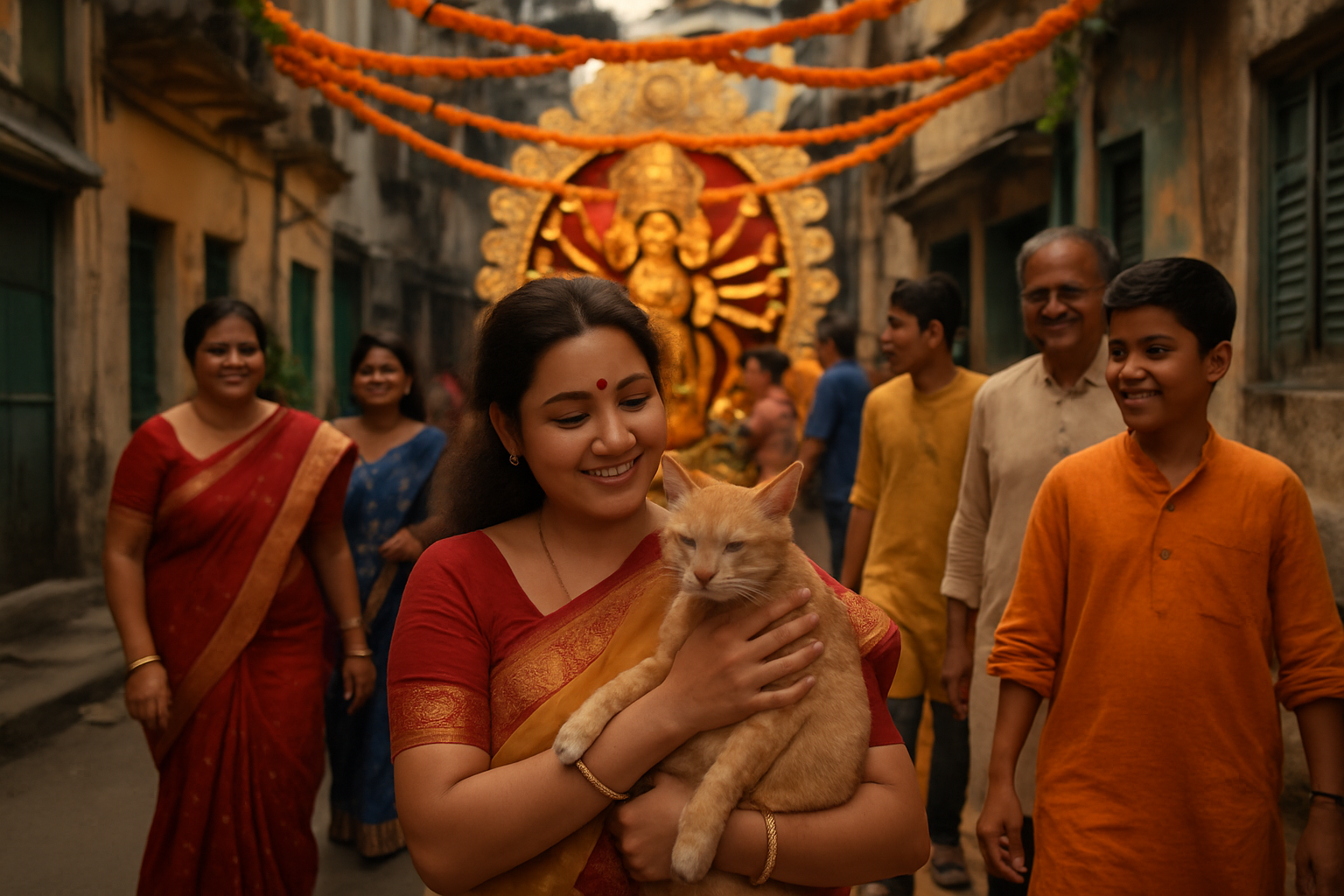
- Crowds and heat are a bigger risk than the idol viewing itself. Pandal-hopping means hours on foot, packed streets, and often warm evenings even in October. Carry water, take breaks, and read your dog's body language rather than pushing through for one more pandal.
- Street food is everywhere — and most of it is unsafe for pets. Onions, excess oil, sweets, and bones from food stalls are easy for a distracted owner to drop or for a curious dog to snatch. Keep a firm leash hold near food stalls specifically.
- Have an exit plan for sudden noise. If a dhak troupe or a burst of crackers starts up unexpectedly nearby, know your nearest quiet side street or the way back to the car before you need it.
Don't Forget the Strays
Kolkata's community dogs and cats don't have a safe room to retreat to. If you have a compound, terrace, or gate, leaving a covered, quiet corner with water available during the loudest nights — Dashami's immersion processions and Kali Puja evening especially — genuinely helps animals with nowhere else to go. It costs nothing and it's the kind of small local action that quietly defines how Kolkata does its festivals differently.
The Bottom Line
Generic festival-safety advice treats Puja season like a single bad night to survive. In Kolkata, it's a five-week arc — Mahalaya, the pandal crowds, the dhak-led immersion nights, and then Kali Puja's fireworks right on its heels. Pets that get support early, with desensitisation, solid ID, and a genuinely familiar safe space, tend to come through the whole stretch far calmer than pets whose owners only start reacting once the first firecracker goes off.